

🍫 Chocolate Toppings Explained
Why syrup stays liquid, fudge gets gooey, and shell hardens in seconds

Last week, we dug into different types of ice cream like custards, gelatos, and no-churns. This week, we’re moving on to something just as important: the toppings.
When I was growing up, my elementary school was just around the corner from a Dairy Queen, a genius move by whoever picked that location. On hot summer afternoons, I’d beg to stop their on the way home. I always ordered the classic, vanilla soft serve dipped in chocolate shell. I loved how it hardened in seconds and cracked with every bite, but still felt creamy once it melted in your mouth.
One day, I switched things up and ordered a hot fudge sundae. And I couldn’t help but wonder—why didn’t the hot fudge harden like the chocolate dip?
That question stuck with me until I finally found the answer.
Each topping behaves differently because of its fat composition, water activity, emulsification, and crystallization. Basically, every drizzle is its own mini chemistry experiment.
Let’s break down the science behind chocolate syrup, hot fudge, magic shell, and melted chocolate so you can understand why they act the way they do.
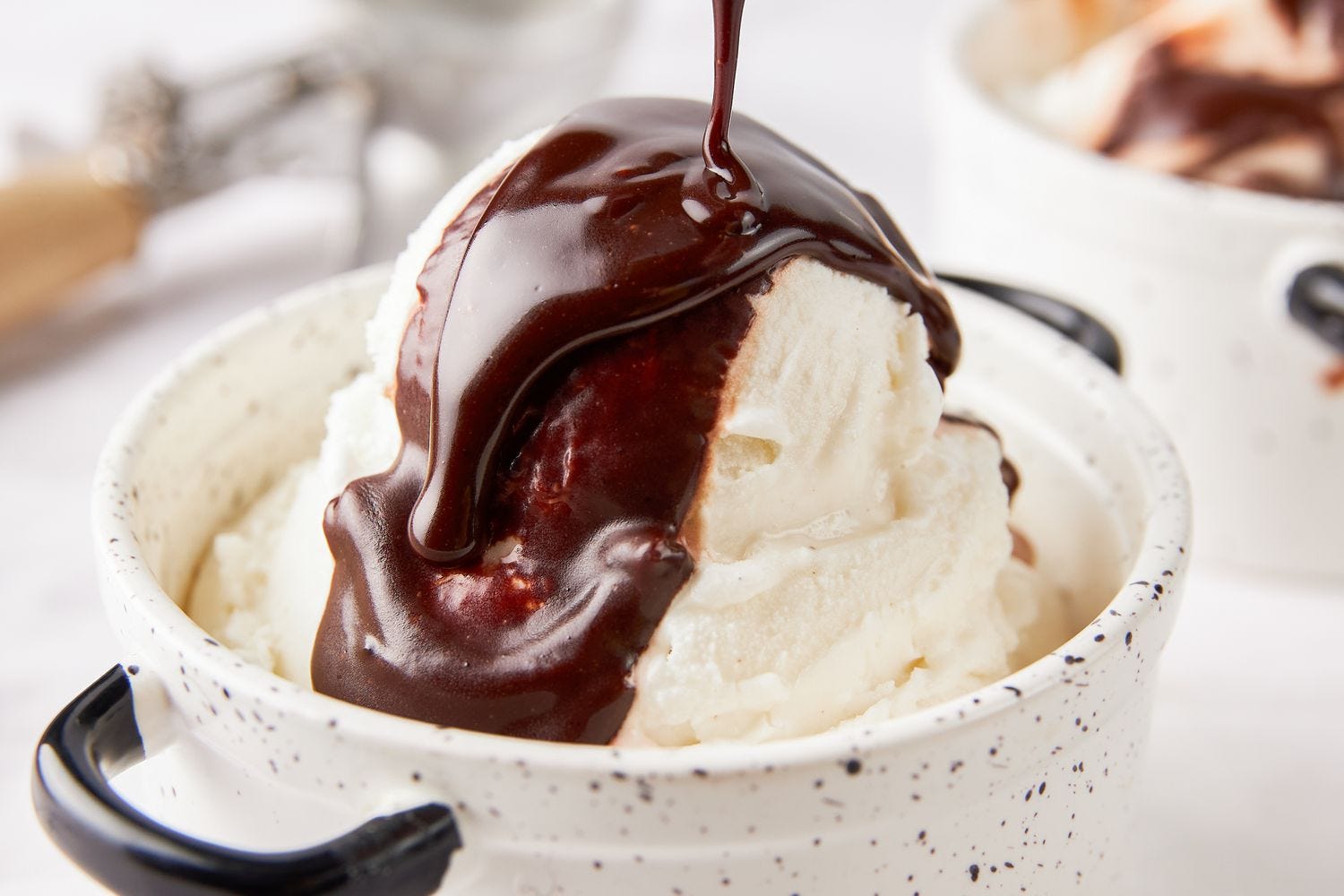
🍫 Chocolate Syrup: The Classic Drizzle
What it is: A blend of cocoa powder, sugar, and water or corn syrup.
Why it stays liquid: Chocolate syrup is water-based. The water doesn’t freeze solid because of the amount of sugar added. Sugar lowers the freezing point (a concept known as freezing point depression). The sugar/water combo helps it resist solidification on frozen surfaces.So instead of hardening, it turns into a slightly thicker, still-fluid sauce.
🍫 Hot Fudge: Gooey and Rich
What it is: A mix of cocoa, cream, butter, sugar, and sometimes corn syrup.
Why it thickens but doesn’t harden: Hot fudge is all about the emulsion, a stable mix of fat and water, with help from milk proteins and sugar. As it hits ice cream, it cools and thickens. This is a semi-stable emulsion where fats are dispersed in water. As it cools, viscosity increases but not enough to form a solid due to moisture content and emulsifier behavior. Instead, it becomes extra gooey and rich.
🍫 Magic Shell: Instant Snap
What it is: Chocolate mixed with coconut oil (or other oils high in saturated fat, like palm kernel oil).
Why it hardens right away: Coconut oil melts at just ~76°F (24°C) so when it hits frozen ice cream, it solidifies in seconds. It’s a fat-based system with no water activity. The saturated fats crystallize rapidly, creating a firm, glassy shell. There’s no water to interfere, and the high-fat content gives it that signature snap.
🍫 Melted Chocolate: The Letdown
What it is: Plain melted chocolate.
Why it doesn’t work well on ice cream: When you pour melted chocolate onto ice cream, it seizes up or turns waxy and brittle. That’s because chocolate contains cocoa butter, which requires tempering a process that controls how fat crystals form.
Without tempering, chocolate cools into unstable polymorphs (fat crystal forms), leading to unpleasant texture and dull appearance. Seizing happens: a thick, gritty mess.
🍨 The Final Scoop
Even the simplest toppings are full of chemistry. Whether you’re into a smooth drizzle, a crisp shell, or a gooey bite, now you know why they all behave differently.
🍫 DIY Magic Shell Recipe
200 grams chocolate chips or chopped chocolate
50 grams coconut oil
Melt together, let cool slightly, then pour over ice cream for that instant crackly shell.
🧠 Coming Next Week:
“Cobbler vs. Crisp vs. Crumble: A Battle of Butter, Texture & Tradition”
📬 Subscribe to stay in the loop and bring a fork.
Stay Sweet,
Sarah @HalfBatchBaking
Everything I never knew I needed to know about chocolate toppings! 😍